Every small business has a graveyard of SOPs. They live in a Google Drive folder labeled "Processes" that someone created during a motivated weekend eighteen months ago. The onboarding checklist is seven steps out of date. The client intake form references a tool you replaced in Q3. The monthly close procedure still has Jessica's name on it, and Jessica left in January.
The problem was never writing the SOPs. The problem is that SOPs are static documents describing dynamic processes. They tell people what to do but can't make sure it happens. And the moment a procedure changes — a new tool, a new team member, a new compliance requirement — the document falls behind reality.
That gap between "written down" and "actually executed" is where AI agents are making the biggest operational difference in 2026. Not by writing better SOPs. By running them.
The SOP Compliance Problem Nobody Wants to Admit
If you manage operations in a company with 10 to 200 employees, you already know the pattern. You document a process. You train people on it. Three months later, everyone has developed their own shortcut. The SOP says "update the CRM within 24 hours of client contact." In practice, the CRM gets updated when someone remembers, usually right before a pipeline review meeting.
Companies with well-documented SOPs experience 50% fewer operational errors — but only when those SOPs are actually followed. The documentation itself isn't the value. The execution is. And execution depends entirely on humans remembering to do things in the right order at the right time, which is exactly what humans are worst at when they're busy.
This is why SOP initiatives have a reputation for dying quietly. The documents get written, a folder appears on a shared drive, and within two months everyone is back to doing things their own way. The founder who wrote those SOPs during that motivated weekend? They stopped checking compliance in week three because they were busy closing deals.
From Documentation to Execution
The shift happening right now isn't about better SOP templates or fancier documentation tools. It's about turning procedures from things people read into things agents do.
Agent Operating Procedures— the term gaining traction in the AI operations space — are natural language instructions that compile into validated workflows for AI agents. Instead of describing what a human should do, they describe what an agent will do. The SOP becomes the agent's instruction set, not a reference document gathering dust.
Here's what that looks like in practice. Take a client onboarding procedure that currently has twelve steps: send welcome email, create project folder, set up billing, schedule kickoff call, assign account manager, populate CRM, send intake questionnaire, review questionnaire responses, create project timeline, set up reporting dashboard, send team introduction, file signed contract.
In the old model, an operations coordinator works through that list over two to three days, sometimes dropping a step, sometimes doing things out of order, sometimes forgetting the intake questionnaire until the kickoff call when the client mentions they never received it.
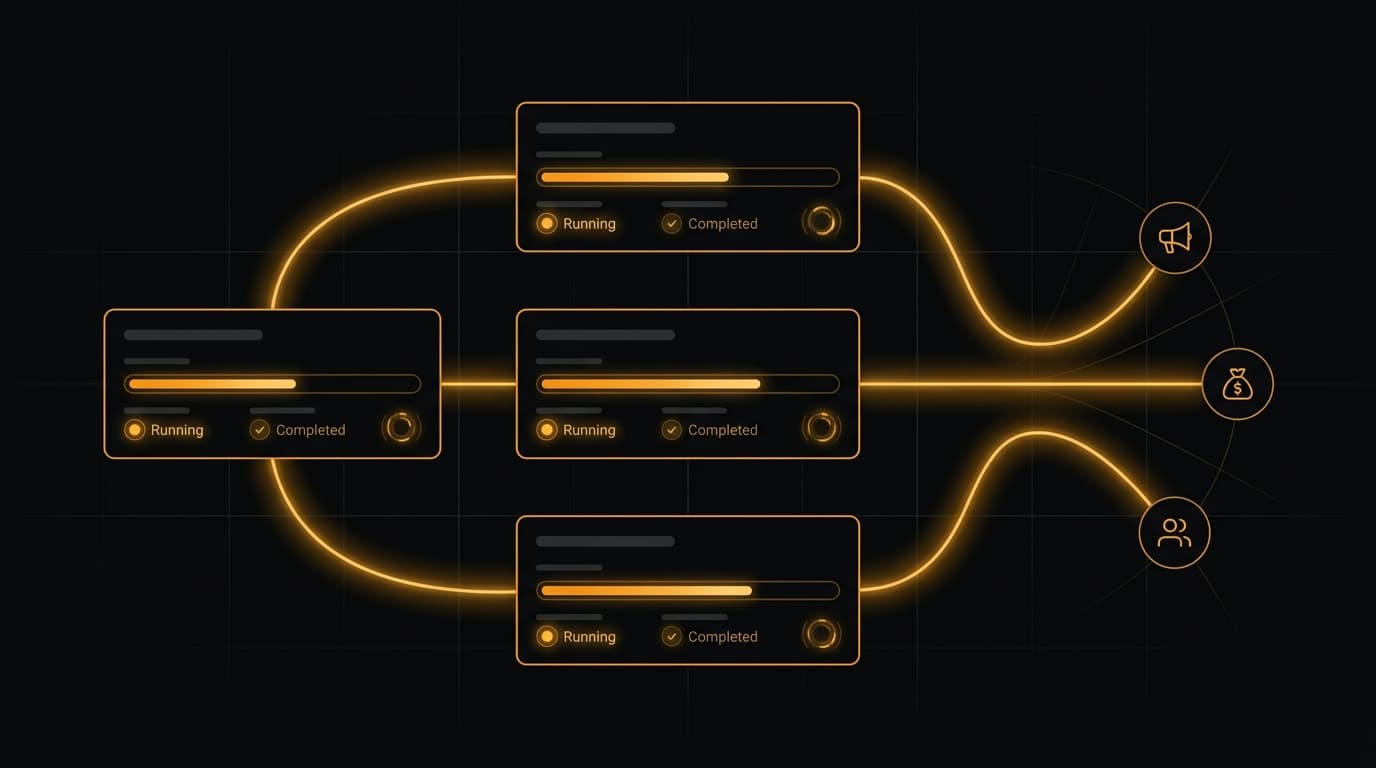
In the agent model, a single trigger — "new client signed" — kicks off the entire sequence. The agent sends the welcome email, creates the folder structure, configures billing in your invoicing tool, books the kickoff on available calendars, updates the CRM, fires off the intake form, and queues the remaining steps that need human input (like reviewing questionnaire responses) in an approval queue with full context attached.
The twelve-step process still happens. Every step still gets done. But now nobody has to remember to do them.
The Three Tiers of SOP Automation
Not every procedure can or should run without human involvement. The most effective approach sorts your SOPs into three tiers based on how much judgment each step requires.
Tier 1: Fully Autonomous
These are procedures with zero ambiguity. The trigger is clear, the steps are deterministic, and the outcome is binary — it either happened correctly or it didn't. Examples:
- Sending a standardized follow-up email three days after a meeting
- Creating a project folder with a predefined structure when a deal closes
- Generating and sending a weekly status report every Monday at 9 AM
- Updating a CRM record when a form submission arrives
- Routing an inbound support request to the correct department based on keywords
These SOPs should run entirely on autopilot. Organizations implementing agentic automation report 30-50% reductions in process time on these routine workflows because the latency between "trigger event" and "action taken" drops from hours or days to seconds.
Tier 2: Agent-Prepared, Human-Approved
These procedures involve a judgment call at one or more steps, but the preparation work around that judgment is mechanical. The agent does everything up to the decision point, presents the relevant information, and waits for approval before continuing.
- Processing a refund request — agent pulls purchase history, checks policy, calculates amount, then queues for manager approval
- Drafting a client proposal — agent assembles scope, pricing, and timeline from templates, then routes for review
- Handling an employee PTO request — agent checks team coverage, calculates remaining balance, flags conflicts, then queues for supervisor sign-off
The human still makes the decision. But instead of spending twenty minutes gathering context and five minutes deciding, they spend five minutes reviewing a pre-assembled package and one minute approving or adjusting. This is where guardrails matter most — defining exactly what the agent can do autonomously and where it must pause for human input.
Tier 3: Human-Led, Agent-Assisted
These are procedures where the human drives the process but the agent handles the surrounding logistics. Think of it as an operations co-pilot.
- Running a quarterly business review — the human leads the conversation, the agent pre-generates the analytics deck, pulls KPIs, and auto-distributes meeting notes afterward
- Conducting a performance review — the human has the conversation, the agent compiles the employee's metrics, peer feedback, and goal progress beforehand
- Negotiating a vendor contract — the human negotiates, the agent tracks redlines, flags deviations from standard terms, and files the executed agreement
How to Audit Your SOPs for Automation Potential
Before you start converting procedures into agent workflows, you need to know which ones are worth automating and in what order. Here's a practical scoring method:
Frequency score (1-5):How often does this SOP run? Daily processes score 5. Annual processes score 1. A procedure that runs fifty times a month and takes fifteen minutes each time is burning twelve hours of labor monthly. That's your highest-frequency target.
Failure cost (1-5): What happens when this SOP gets skipped or done wrong? If a missed step means a compliance violation or lost client, score it 5. If it means a slightly messy folder structure, score it 1.
Complexity score (1-5, inverted): How many judgment calls does the procedure require? Fully deterministic processes score 5. Processes requiring constant human judgment score 1. This is your automation feasibility indicator.
Multiply the three scores together. A daily client follow-up (frequency: 5) that loses deals when missed (failure cost: 4) and requires no judgment (complexity: 5) scores 100. A quarterly strategic planning session (frequency: 1) with high stakes (failure cost: 4) that's entirely judgment-based (complexity: 1) scores 4. Start with your highest-scoring procedures.
Our breakdown of 35 automatable processes uses this same prioritization logic if you want a head start on identifying candidates.
Writing SOPs That Agents Can Actually Execute
Traditional SOPs are written for human interpretation. They assume context, allow ambiguity, and rely on the reader's judgment to fill gaps. Agent-executable SOPs need to be different. Not longer — just more precise.
Define triggers explicitly."When a new client is onboarded" is ambiguous. "When a deal in HubSpot moves to status 'Closed Won'" is executable. Every agent SOP starts with a trigger condition that maps to a specific system event.
Specify the system for each action."Send a welcome email" doesn't tell the agent which email tool, which template, or which sender address. "Send template 'client-welcome-v3' from the account manager's email via the connected email integration" does.
Include escalation conditions.Every step that could fail needs a fallback. What happens if the calendar integration can't find an available slot? What if the CRM field is missing required data? Agents don't improvise — they follow the procedure or escalate. Your SOP needs to tell them when to do which.
Set time boundaries."Follow up after the meeting" is vague. "Send follow-up email 4 hours after meeting end time; if meeting notes are not available, wait 24 hours and retry once before escalating" gives the agent clear operational parameters.
Building SOPs that power agentic AI is a documentation discipline, not a technical challenge. If you can describe the process clearly enough for a new hire to follow without asking questions, you can describe it clearly enough for an agent.
The Rollout: Shadow Mode First
Converting a manual SOP to an agent workflow is not an all-or-nothing switch. The safest rollout follows a progression:
- Shadow mode — The agent runs alongside the human process. It executes every step but sends outputs to a review queue instead of taking live action. You compare the agent's decisions against what the human actually did. This reveals gaps in the SOP and calibrates your trust.
- Assist mode — The agent prepares each action and proposes it. The human approves each step with a single click. This is Tier 2 behavior applied temporarily to Tier 1 procedures until you're confident in accuracy.
- Autonomous mode — The agent runs independently. Humans receive a daily or weekly digest of completed actions for oversight, but individual steps don't require approval.
This progression typically takes two to four weeks per procedure. SOP-driven agent frameworks that follow this shadow-to-autonomous pattern report accuracy rates above 99% on routine procedures because the shadow period catches edge cases before they reach production.
What Changes When Your SOPs Actually Run
The downstream effects of self-executing SOPs go beyond time savings. Deloitte's 2026 tech trends report notes that organizations with agentic AI handling routine operations see improvements in three areas that static SOPs never touched:
Consistency across team members. When five people follow the same SOP, you get five slightly different versions of the process. When an agent follows the SOP, you get one version, every time. Client experience becomes uniform regardless of which team member is nominally responsible.
Process visibility. Every agent action is logged. You can see exactly when each step happened, how long it took, what data was processed, and where escalations occurred. Try getting that level of visibility from a human-executed checklist. The SOP becomes self-auditing.
Continuous improvement.Because every execution is tracked, patterns emerge. You notice that step seven always takes longer than expected because it depends on data from a system that's slow to respond. You notice that step three generates the most escalations, suggesting the SOP needs clearer rules for that decision point. The data from execution feeds back into better procedures — a loop that doesn't exist when SOPs live in documents.
Starting With Five
You don't need to convert every procedure in your business to an agent workflow this quarter. Start with five. Pick the ones that scored highest in your audit — high frequency, high failure cost, low complexity.
For most SMBs, the first five are some combination of:
- New client onboarding sequence
- Invoice follow-up and collections workflow
- Weekly reporting and KPI compilation
- Employee onboarding checklist execution
- Post-meeting follow-up and task extraction
These five procedures alone account for dozens of hours of manual operations work per month in a typical 20-50 person company. Converting them to self-executing agent workflows gives you immediate time back while building the operational muscle for more advanced automation down the line.
40% of business workflows are projected to be agent-managed by the end of 2026. The companies that get there won't be the ones that wrote the best documentation. They'll be the ones that stopped treating SOPs as documents and started treating them as executable software.
Ready to turn your SOPs into workflows that actually execute? Start a 30-day pilot and see your first five procedures running autonomously within two weeks.
Frequently Asked Questions
What does it mean for an SOP to run itself?
A self-running SOP is a standard operating procedure that has been converted from static documentation into an executable workflow powered by AI agents. Instead of a human reading the steps and performing them manually, an AI agent interprets the procedure, executes each step across your connected systems, and only escalates to a human when a decision falls outside its defined authority. The SOP becomes the agent's instruction set rather than a reference document.
How do AI agents handle SOPs that require judgment calls?
Well-designed agent SOPs include escalation tiers. Routine steps (sending a follow-up email, updating a CRM record, generating a report) run autonomously. Steps requiring judgment (approving a refund over a certain amount, making an exception to policy) get routed to a human approval queue. The agent handles the preparation work and presents the decision with full context, so the human only spends time on the actual judgment — not the busywork surrounding it.
Can small businesses with no existing SOPs benefit from this approach?
Yes, and in some ways more easily. Small businesses often run on tacit knowledge — processes that live in the founder's head. AI SOP tools can interview stakeholders, observe existing workflows, and generate documented procedures in minutes instead of the hours manual writing requires. Starting from scratch means there are no outdated documents to reconcile. The AI generates the SOP and immediately begins executing it, so documentation and automation happen in one step.
Sources
- From Manual SOPs to Automated AI Logic: Agent Operating Procedures — Decagon
- Agentic AI Stats 2026: Adoption Rates, ROI, and Market Trends — OneReach.ai
- Agentic AI Strategy: Tech Trends 2026 — Deloitte Insights
- Introducing the SOP-Driven LLM Agent Framework — Grab Engineering
- Building SOPs That Power Agentic AI — Skan.ai
- Agentic AI Orchestration: Automating Workflows at Scale — OneReach.ai
- How to Improve Regulatory Compliance With SOP Programs — OXmaint