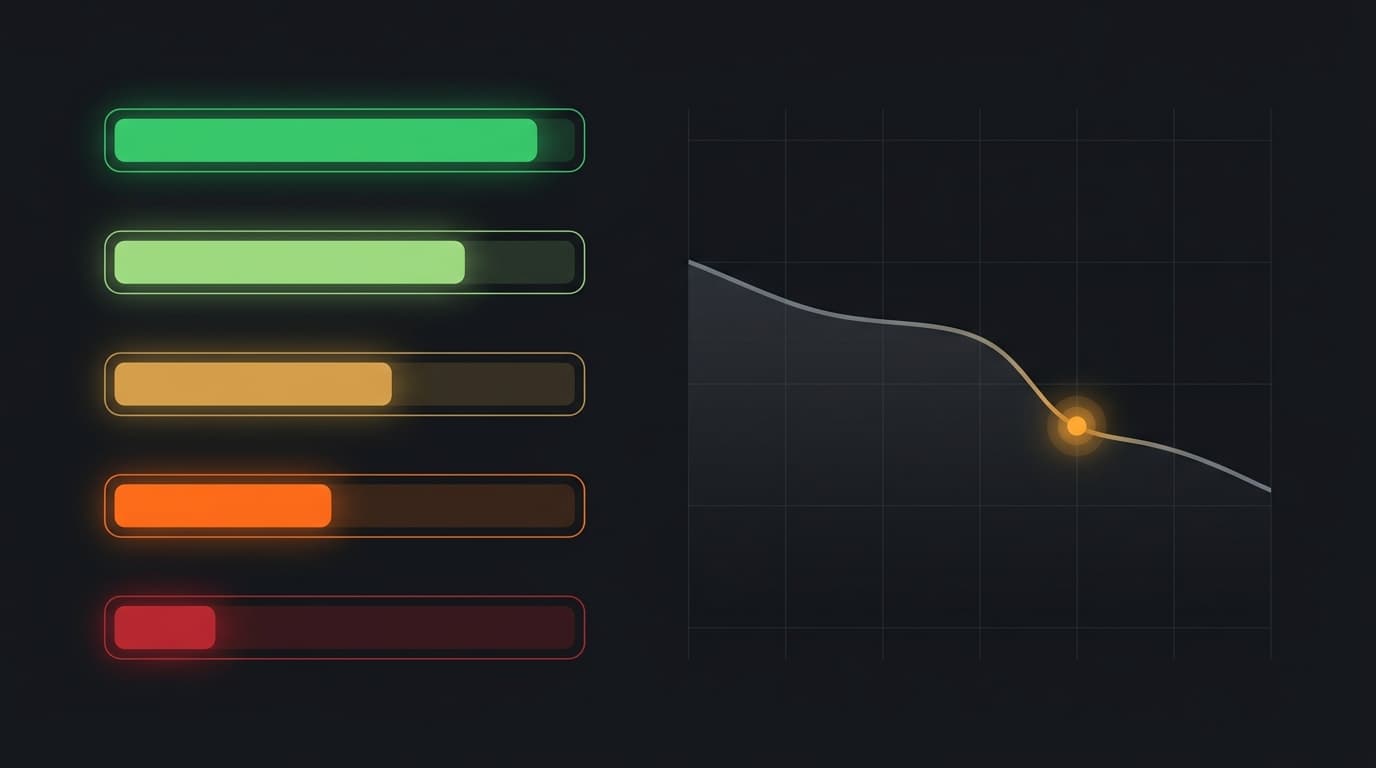
A client churns. You did not see it coming. When you pull up their account history, the signs were there for weeks — declining engagement, fewer logins, support tickets that went from questions to complaints, a champion who left the company two months ago. Every signal was visible. Nobody was watching.
This is the problem customer health scoring solves. Not with a dashboard you check on Fridays. Not with a quarterly business review that arrives thirty days too late. With a continuous, multi-signal score that updates in real time and flags the moment something shifts.
The Gap Between What You Know and What Is Happening
Most businesses learn about at-risk clients from lagging indicators: a cancellation email, a missed payment, a terse reply to a renewal outreach. By the time you are reacting, the decision has already been made.
Bain & Company's 2025 retention research mapped the typical churn timeline into three stages. The early warning stage — usage changes, engagement dips — begins 60 to 90 days before cancellation. Active disengagement, where support interactions decline and responsiveness drops, runs from 20 to 40 days out. The final stage, decision-made, covers the last 20 days. By then, procurement is already evaluating replacements.
Manual account reviews almost always catch clients in that final stage. Save rates at that point drop below 10%. The math is straightforward: if your intervention happens in the first stage, you have months and room to maneuver. If it happens in the third, you have neither.
What a Health Score Actually Measures
A health score is a single number — typically 0 to 100 — that reflects the likelihood a client will renew, expand, or leave. The number itself is less important than the signals feeding it.
Effective scoring systems combine four categories of input, each weighted by its correlation to actual retention outcomes:
Product usage (typically 40% of score weight) — Login frequency, feature breadth, session duration, and usage trends over time. A client who logged in daily for six months and now logs in twice a week is a different risk profile than one who has always logged in twice a week. The trajectory matters more than the absolute number.
Engagement quality (25%) — Email open rates, response times, meeting attendance, content consumption. A client who stops opening your emails is not necessarily angry. But a client who stops opening emails, declines a meeting, and has not logged in for nine days is telling you something.
Support experience (20%)— Ticket volume, resolution time, sentiment in support interactions, and the direction of ticket topics. A shift from “how do I do this?” to “why is this broken?” is a signal that quantitative metrics alone will miss.
Business fit (15%)— Contract value relative to usage, expansion history, industry benchmarks, and whether the client's stated goals align with what they are actually doing in the product. A client paying for an enterprise tier who uses three features is either underserving themselves or overcommitting on spend. Both are risk factors.
Forrester's 2025 Customer Success Technology report found that companies using composite health scores with four or more signal dimensions achieve 34% better churn prediction accuracy than those relying on a single dimension like usage or NPS alone.
Why Manual Scoring Fails at Scale
Some teams build health scores in spreadsheets. A CSM reviews each account weekly, assigns a red-yellow-green status, and updates a shared document. This works with 15 accounts. It collapses at 50.
The failure mode is not laziness — it is physics. A human reviewing an account manually is looking at a snapshot. They see today's data, filtered through their own recency bias and emotional read of the last conversation. They do not see the trailing 90-day engagement curve. They do not notice that this client's support ticket sentiment shifted from neutral to negative over the last three weeks. They do not cross-reference the fact that the client's primary contact changed roles internally, which historically correlates with a 2.3x increase in churn probability.
Automated systems see all of this simultaneously, across every account, updated continuously. Gainsight's 2025 Customer Success Benchmark report found that automated health scores detect churn risk an average of 63 days before cancellation — compared to 11 days for manual CSM assessment. That is a 52-day head start. In a business with 90-day contract cycles, 52 days is the difference between saving the account and writing the loss into next quarter's forecast.
How AI Changes the Equation
Traditional health scores are rules-based: if usage drops below X, flag it. If NPS is below Y, flag it. These rules are static, and they treat every account the same way.
AI-driven scoring works differently. It learns from your actual retention data — which signal combinations preceded past churns, which patterns preceded expansions — and weights its model accordingly. A 20% usage drop might be catastrophic for one client segment and perfectly normal for another (seasonal businesses, for instance, have inherently cyclical usage patterns). A rules-based system treats them identically. A trained model distinguishes between them.
The practical differences show up in three areas:
Pattern recognition across signals.AI detects compound signals that no single metric captures. A client whose usage is stable but whose support sentiment is declining and whose champion just changed titles — that combination might not trip any individual threshold, but the model recognizes it as a pattern that preceded 40% of last year's churns.
Continuous recalibration. As your business changes — new features ship, pricing shifts, market conditions evolve — a static scoring model drifts out of alignment. AI models retrain on fresh data, adjusting weights as the relationship between signals and outcomes shifts.
Behavioral drift detection. This is where things get interesting for teams running AI agents. If an agent responsible for client communication starts producing outputs that diverge from its configured parameters — sending fewer touchpoints, using different messaging, or skipping scheduled check-ins — the health scoring system flags the drift before it affects client outcomes.
What an AI Health Alert Looks Like in Practice
A useful alert is not “Client X is at risk.” That tells you nothing actionable. A useful alert includes context: what changed, when the trend started, what the model recommends, and how confident it is.
Here is what a well-structured health alert contains:
- Score change — “Acme Corp health score dropped from 78 to 54 over the past 14 days”
- Contributing signals — “Primary drivers: login frequency down 60% (was 12/week, now 5/week), last three support tickets marked negative sentiment, no response to last two outreach emails”
- Historical context — “This pattern matches 7 of 12 accounts that churned in Q1 at similar contract stages”
- Recommended action — “Schedule executive check-in within 5 business days. Prepare value reinforcement deck focused on features the client is underusing”
- Confidence level — “Model confidence: 82%”
The difference between this and a red dot on a spreadsheet is the difference between information and intelligence. One tells you something is wrong. The other tells you what to do about it.
In Palatai, these alerts surface in the morning briefing's anomaly section — alongside revenue anomalies, pipeline irregularities, and agent performance flags. The operator scans, decides, and acts. No digging through dashboards. No waiting for a weekly sync.
The Retention Math
The economics of early detection are not subtle. Bain & Company's research on retention economics found that a 5% reduction in churn translates to a 25-95% increase in profitability, depending on industry. For a SaaS business doing $2 million in ARR with 8% annual churn, reducing churn to 6% adds $40,000 in retained revenue in year one — and that compounds.
Totango's 2025 State of Customer Success study found that SaaS companies using automated health scoring reduce gross churn by 23% within twelve months of deployment. McKinsey reported that companies implementing autonomous AI agents for retention saw a 15-20% churn reduction within the first six months.
Those are not marginal improvements. For most businesses, the cost of implementing health scoring is recovered in the first quarter through retained accounts that would have otherwise been lost.
Building a Scoring System That Works
If you are starting from scratch, the sequence matters. Scoring systems fail when teams try to measure everything at once. Start narrow, validate, then expand.
Start with four to six signals. Choose metrics you already have reliable data for. Login frequency, support ticket volume, email engagement, and contract renewal date are available in almost every business. Do not wait for perfect data — start with what you have.
Weight by correlation, not intuition. Run a retrospective analysis: look at your last 20 churns and your last 20 renewals. Which signals differed most between the two groups? Weight those signals higher. Your intuition about what matters might be right. It might also be anchored to one memorable account that is not representative.
Set thresholds based on historical data.A “healthy” score should align with accounts that actually renewed. A “critical” score should align with accounts that actually left. If your thresholds are not calibrated to real outcomes, you are generating noise, not signal.
Automate the response, not just the score. A health score without a triggered workflow is a number nobody acts on. When a score drops below a threshold, something should happen automatically: a task assigned, an email queued, a Slack notification sent, or an agent dispatched to gather more context before a human intervenes.
Review and recalibrate quarterly. Your business changes. Your clients change. Your product changes. A scoring model built in January that is never updated will be measuring the wrong things by July. Block time to review signal weights, threshold accuracy, and false positive rates.
What This Means for Operators Running AI Teams
If you are managing a team of AI agents across departments — sales, marketing, operations, support — customer health scoring becomes the connective tissue between them.
Your sales agent knows which deals closed. Your marketing agent knows which content the client engaged with. Your support agent knows the tone and frequency of recent tickets. Your operations agent knows whether the client's integrations are healthy and whether their data pipelines are running clean.
Individually, each agent holds a partial view. Aggregated into a health score, those signals form a complete picture that no single human — and no single agent — could assemble on their own.
The operator's role shifts from monitoring individual accounts to monitoring the system that monitors them. You are not checking on Client X. You are checking whether the scoring model is catching the right patterns, whether the automated responses are triggering at the right thresholds, and whether the agents feeding signals into the model are producing accurate, timely data.
This is the operating model that scales. Not more CSMs. Not more spreadsheets. Not more meetings about accounts that were already lost. A scoring system that watches continuously, alerts early, and recommends specifically — so you spend your time on the 10% of accounts that actually need your judgment, not the 90% that are fine.
Gartner projects that by 2029, agentic AI will autonomously resolve 80% of common customer service issues without human intervention. The organizations that reach that benchmark will not get there by replacing humans with agents. They will get there by giving agents the right signals — and health scoring is where those signals converge.