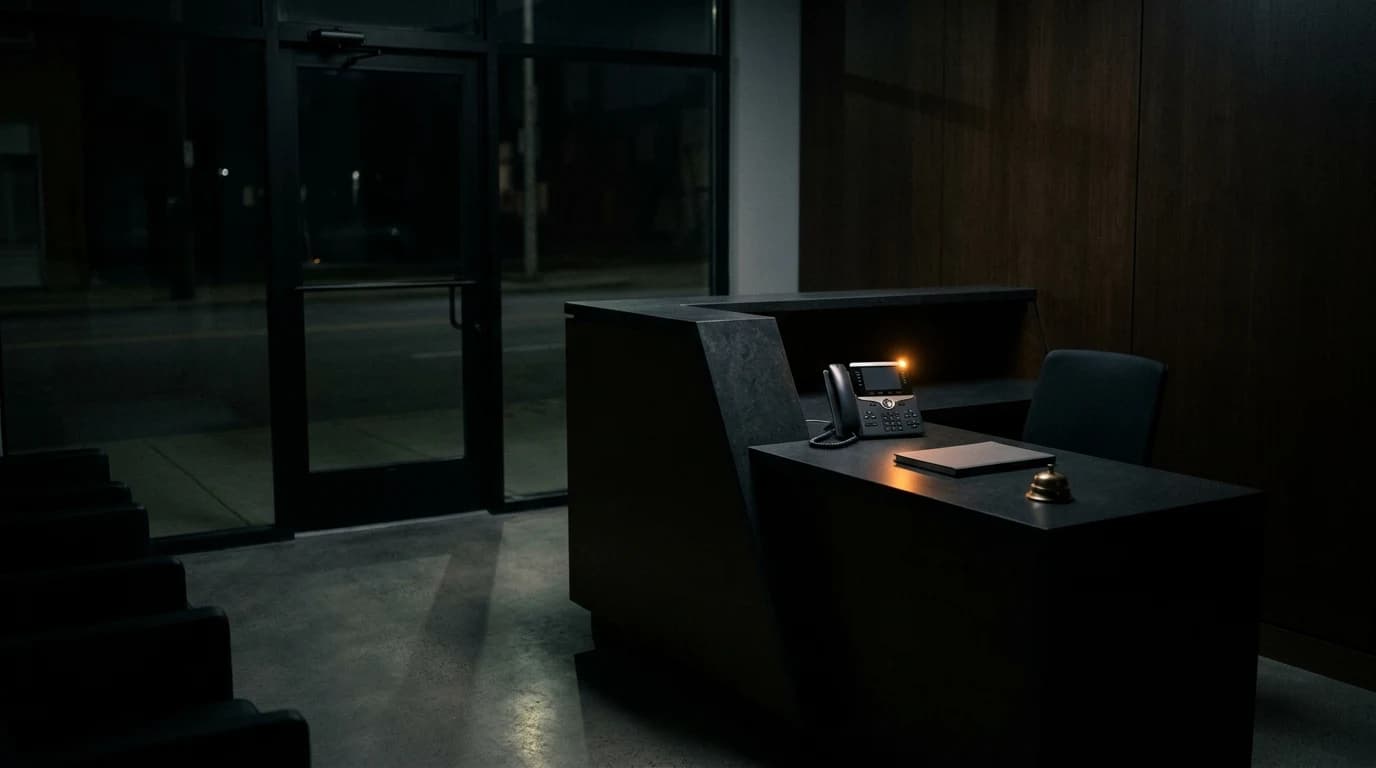
A part-time receptionist on 20 hours a week is at the desk for 12% of the hours in a week. The phone does not stop ringing for the other 148. That gap is the real question behind AI receptionist vs human receptionist, and most of the comparisons online skip it.
Those comparisons set an AI tool against a full-time, fully loaded hire. A small business weighing this choice rarely has a full-time front desk to replace. The usual choice is a part-time hire or software. Our verdict: if your customers reach you mostly by phone, chat and text, pick software over a 20-hour hire. Hire the person if people walk through your door every day. Below, we price both from Bureau of Labor Statistics data and Palatai's published prices, name the call volume that flips the math, and set out what each option cannot do.
What a Part-Time Receptionist Costs
The BLS puts the median wage for receptionists at $18.27 an hour (May 2025 data). At 20 hours a week for 52 weeks, that is 1,040 hours and about $19,000 in pay.
Pay is not the whole cost. In June 2026, wages made up 80.0% of what private employers spent on their part-time workers. Benefits, including legally required payroll taxes, made up the other 20.0%. That share is lower than the 30% for all workers, because part-time staff usually get fewer benefits. Dividing pay by 0.80 gives a rough employer cost:
| Schedule | Hours a year | Pay at $18.27/hr | Approx. employer cost | Per month |
|---|---|---|---|---|
| 20 hours a week | 1,040 | ~$19,000 | ~$23,750 | ~$1,980 |
| 30 hours a week | 1,560 | ~$28,500 | ~$35,630 | ~$2,970 |
Read these as a starting point, not a quote. The wage is a national median, so your local rate may be higher or lower. The 80% figure is an average across all private-industry part-time jobs, not receptionists in particular. If you offer no benefits beyond what the law requires, your cost will sit closer to the pay line plus payroll taxes. The table also leaves out hiring, training, and cover for sick days and vacations.
What Palatai's AI Receptionist Costs
Palatai's AI Receptionist is a department you add to the Platform Base. Every figure here comes from the pricing page:
- $1,147 a month: the $397 Platform Base plus the $750 Receptionist department.
- $2,500 one-time setup. This covers connecting the voice and SMS providers, setting up your phone number, embedding the chat widget, matching your brand voice, loading your knowledge base, and testing inbound scenarios before go-live.
- Always-On Channels are included in the Receptionist department, so that add-on is not billed twice.
- Annual billing is the monthly price times 10: $11,470 a year, about $956 a month.
Year one comes to $16,264 on monthly billing, or $13,970 on annual billing, with setup included either way. The Platform Base is not a receptionist-only cost. It also covers the task board, approval gates, the core CRM and a monthly AI credit allowance that the rest of the AI team uses.
Two costs sit outside the $1,147. First, voice and text run on your own Retell and Twilio accounts. Palatai uses a bring-your-own-provider model, so the carrier relationship stays with you, and those providers bill you directly for call minutes and text messages at their own rates. Check their rates against your monthly call volume before you compare totals. Second, refunds. The published 30-day money-back guarantee covers the Platform Base, every active department and any recurring add-ons, and excludes AI credit overages you have already used. The policy does not mention the one-time setup fee, so ask [email protected] how it is handled before you pay.
Palatai is also more than a phone answerer, and you may not need more. If all you want is calls picked up and messages emailed to you, compare the published prices of standalone answering tools before you decide. The difference is what happens after the answer, which the next sections cover.
Coverage Hours: Where AI Receptionist vs Human Receptionist Differ Most
A week has 168 hours. A 20-hour receptionist covers 12% of them and a 30-hour receptionist covers 18%, before lunch breaks and sick days. Part-time shifts usually fall inside business hours. Evening, weekend and holiday calls go to voicemail or to an answering service you pay for separately.
A person also takes one call at a time. While they are on the phone, the second caller waits on hold or goes to voicemail, and nobody answers the website chat or the text line. Palatai's AI receptionist answers calls, chats and texts around the clock, on all three channels at once.
How many calls you miss today is your own number, and it is worth knowing before you buy anything. Pull one month of your phone system's call log. Count the unanswered calls and note the time each one came in. If most fall outside your open hours, coverage is the problem. If most fall during open hours, the desk is short-staffed while you are open.
Missed Calls: AI Receptionist vs Human Receptionist
With a part-time receptionist, an off-hours call goes to voicemail and waits for the next shift. Someone then has to listen, write it down and call back. Each step depends on a person remembering to do it.
The AI receptionist answers from a knowledge base you set up: your services, hours, frequently asked questions and instructions. With Google Calendar connected, it checks availability and books the slot during the call. With another scheduling system, it captures the request and creates a task for a person to confirm. When a question is outside what it has been told, it takes a message and flags it for follow-up, or transfers the caller to a person if one is available.
Every contact becomes a CRM record and a task on your board with the full context, so the morning starts with a list rather than a voicemail inbox. Replies to email can be drafted for your review before they go out. Our post on approval gates explains how you decide which work needs a sign-off.
For a front desk that serves high-end or international clients, the same Receptionist department can run Palatai's AI Concierge persona, which can answer in Spanish, French, Mandarin and other languages at the same price.
What an AI Receptionist Cannot Do
Start with the door. An AI receptionist has no hands and no face, so it cannot sign in a visitor, take a card at the counter, accept a package or walk a client back to a room. If people come in every day, someone has to be standing there.
Judgment is the second limit, and it shows up on the phone too. A regular who is upset, or a caller who has just had bad news, needs someone who knows them. So does the request to squeeze in an emergency or make an exception this once. The AI follows its instructions. Anything outside them goes back to you, or to a person it can transfer to, and if nobody is there to take the transfer, the caller gets a message and a callback.
Then there is upkeep. The AI knows only what is in its knowledge base. Change your hours or raise a price and someone has to update it, while a receptionist would hear about it over coffee.
What a Part-Time Receptionist Cannot Do
A part-time receptionist cannot be there outside their shift, and cannot be on two channels at once. When they are sick, on vacation or leave the job, coverage stops until you find and train someone else. All of that falls on you, the owner, which is exactly the job you were hiring someone to take off your plate.
AI Receptionist for Small Business: Which One Fits
For most phone-led small businesses, our recommendation is the AI receptionist over a 20-hour hire. In year one it costs $16,264 on monthly billing against roughly $23,750 for the hire. It also answers all 168 hours of the week rather than 20 of them.
Call volume is what changes that answer. The gap between the two is about $7,490 in year one, or roughly $624 a month, and that gap has to cover your Retell and Twilio bills. Retell publishes voice-agent rates of $0.07 to $0.31 a minute. Twilio charges $0.0085 a minute to receive a call on a US local number, plus $1.15 a month for the number. At Retell's top rate, each answered minute costs about $0.32 between the two. Take the $1.15 number fee out of the $624 and the rest pays for about 1,950 minutes a month, or a little over an hour of talk a day. Text messages come out of the same money, so a business that texts a lot reaches that line sooner. Above that, a 20-hour hire is cheaper on paper. In practice, a business taking that many calls has usually outgrown one part-timer anyway, and the honest comparison becomes a full-time hire. Run your own minutes from the call log before you trust either number.
Walk-ins change the answer too. If people are at your counter every day and the phone is light, hire the person, because the AI cannot do the main part of the job. If you need both, combine them. A person runs the desk during open hours, and the AI takes the phone after hours and whenever that person is busy with someone in front of them. A 20-hour hire plus Palatai on annual billing comes to about $37,720 in year one, plus provider usage. That is roughly $2,100 more than a 30-hour hire alone, and it covers every hour of the week instead of 18% of them.
One case trips up the simple rule: a business whose walk-ins rise and fall with the season. Think of a walk-in clinic that fills up in flu season and goes quiet in summer, or a tax office packed from February to April. A year-round hire sized for the peak sits idle for months. Hiring for the quiet months leaves the desk swamped at the peak. The better setup is usually the AI on the phone all year, plus a seasonal person at the desk for the busy months. The peak is also when the phone needs the AI most, because the person at the desk is busy with the queue in front of them.
Either way, the goal is the same: a business that answers when customers call, not only when you happen to be free.
Price It for Your Own Business
Start with your call log, then build your team on the pricing page. It shows your exact monthly number before you pay anything. For the wider picture of how AI vendors price their agents, see How Much Does an AI Agent Cost?
Short Answers on Cost, Coverage and Setup
An AI receptionist costs less than a 20-hour hire in year one
The BLS median wage for receptionists was $18.27 an hour in May 2025. A 20-hour-a-week part-time hire at that wage costs about $19,000 a year in pay, or roughly $23,750 once employer costs are added at the June 2026 BLS part-time rate (wages are 80% of compensation). Palatai's AI receptionist is $1,147 a month (the $397 Platform Base plus the $750 Receptionist department) plus a $2,500 one-time setup fee, which comes to $16,264 in year one on monthly billing or $13,970 on annual billing. Voice and text run on your own Retell and Twilio accounts, which bill call minutes and messages separately.
An AI receptionist can replace the phone, not the front desk
For the phone, chat and text, often yes. For the front desk itself, no. An AI receptionist cannot greet a walk-in, sign in a visitor, take a payment at the counter or calm an upset regular in person. A salon or clinic with walk-ins every day needs a person at the desk. An AI receptionist can still cover the phone after hours and while that person is with a customer.
An AI receptionist answers after hours; a part-timer's calls go to voicemail
Yes. Palatai's AI receptionist answers calls, website chat and text messages around the clock, including nights, weekends and holidays. A 20-hour part-time receptionist covers about 12% of the 168 hours in a week. Calls outside that shift go to voicemail unless something else answers them.
Palatai charges a $2,500 one-time setup fee
Yes, a $2,500 one-time fee. It covers connecting the voice and SMS providers, configuring your phone number, embedding the chat widget, setting the brand voice, loading your knowledge base and testing inbound scenarios before going live. The Receptionist department already includes Always-On Channels, so that add-on is not billed a second time.
Sources
- Receptionists, Occupational Outlook Handbook, U.S. Bureau of Labor Statistics (median hourly wage $18.27, May 2025 data), accessed October 2026
- Employer Costs for Employee Compensation, June 2026, U.S. Bureau of Labor Statistics (released September 9, 2026; part-time private industry: wages 80.0%, benefits 20.0%)
- Palatai Pricing (Platform Base, Receptionist department, setup fee, annual billing, 30-day guarantee), accessed October 2026
- Palatai AI Receptionist feature page (channels, booking, setup scope), accessed October 2026
- Palatai Always-On Agents feature page (bring-your-own-provider model: customer-owned Retell and Twilio accounts), accessed October 2026
- Palatai Refund Policy (30-day guarantee scope and exclusions), accessed October 2026
- Twilio Voice Pricing, United States (inbound local calls $0.0085 per minute, local number $1.15 a month), accessed October 29, 2026
- Retell AI Pricing (voice agents $0.07 to $0.31 per minute, pay-as-you-go), accessed October 24, 2026